

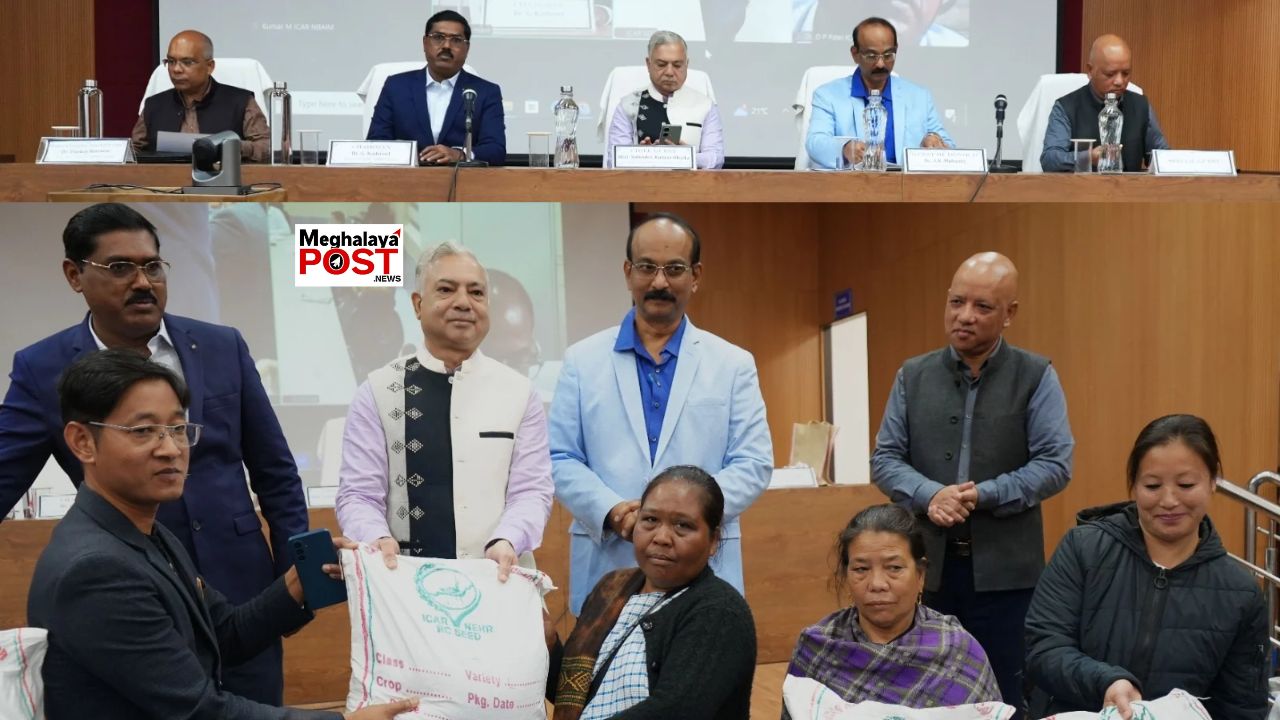
Nongpoh, November 19: The ICAR Institutes, Asssam Agricultural University, Central Agricultural University, and state agricultural and allied departments of North Eastern region launched the “Rice Fallow Intensification Programme for North Eastern region on 19th November 2026 with active involvement of more than 300 participants from various states of NE region including directors and representatives from Tripura, Meghalaya Manipur, Sikkim, Assam and Arunachal Pradesh, Additional Director Generals (ADGs), 90 KVKs and farmers.
The programme aims to bring more than 52,700 ha of rice fallow area under intensification across the North Eastern Region of India through the cultivation of pulses, oilseeds, vegetables and potato. This initiative is expected to enhance the production of oilseeds, pulses, maize and vegetables across the region. Furthermore, it is envisaged to improve cropping intensity and land-use efficiency, strengthen food and nutritional security, diversify farming systems, and enhance farmers’ livelihoods and income through the sustainable utilization of rice-fallow areas.
Addressing the gathering as the Chief Guest, Shri Satindra Kumar Bhalla, Secretary, North Eastern Council (NEC), highlighted that technology alone does not determine the success of a mission. He emphasised the importance of the four key components—Seed, Sowing, Sale and Support (4S)—for the successful implementation of the programme.
Dr. Govindsamy Kadirvel, Director, ICAR RC NEH, Umiam, stressed the importance of active state government intervention in strengthening seed production and large-scale seed propagation. He highlighted the need for reliable data and coordinated efforts to ensure effective implementation. Emphasizing the need for greater self-sufficiency in pulses, oilseeds, meat, fish and eggs, he also underlined the crucial role of Krishi Vigyan Kendras (KVKs) in bringing meaningful changes at the grassroots level.
Dr A. K. Mohanty, Director, ICAR–Agricultural Technology Application Research Institute (ATARI), Umiam; and Shri I. B. Saiborne, Director of Food Processing, Government of Meghalaya, Shillong and Senior officials from ICAR Headquarters, including the Additional Director General (ADG) for Agricultural Extension (Dr Ranjay Kumar Singh) and Additional Director General (ADG) for Soil and Water Conservation (Dr Velmurugan), were also present on the occasion.
The programme will be implemented through a convergence-based approach involving various ICAR institutes, including ICAR–Indian Institute of Oilseeds Research (ICAR-IIOR), ICAR–Indian Institute of Pulses Research (ICAR-IIPR), ICAR–Directorate of Rapeseed and Mustard Research (ICAR-DRMR), ICAR–Indian Institute of Maize Research (ICAR-IIMR), and ICAR–Vivekananda Parvatiya Krishi Anusandhan Sansthan (ICAR-VPKAS), Almora, Central Agricultural University (CAU), Assam Agricultural University (AAU), State Departments of Agriculture, and 90 Krishi Vigyan Kendras (KVKs) across the North Eastern region to ensure effective coordination, technology dissemination, capacity building and large-scale implementation of the programme.
Technological interventions through regular training, awareness and capacity-building programmes are essential to enhance farmers’ knowledge and promote the adoption of improved production technologies. Timely availability and supply of critical inputs, particularly quality seeds and fertilizers, should also be ensured for effective implementation of the programme. Furthermore, a systematic monitoring and evaluation mechanism, supported by periodic impact assessment studies, should be established to track programme progress, evaluate its outcomes and identify areas for further improvement.
The program also focuses on the development of market linkages and processing infrastructure for pulses and oilseeds to enhance profitability and encourage the expansion of cultivation in rice-fallow areas. To ensure adequate seed availability, there is a need to strengthen the regional seed production system and associated infrastructure, thereby reducing dependence on external sources. Toria and lentil seeds were distributed to the farmers from various north eastern states on the occasion.
All the state departments and associated KVKs were requested to join the programme under various missions/ developmental schemes on oilseeds and pulses, Pradhan Mantri Krishi Sinchayee Yojana (PMKSY), Sub-Mission on Agricultural Mechanization (SMAM) for further intensification of rice fallow cultivation. The information also should be effectively integrated with the initiatives of ICAR institutes and State Agricultural Universities.
Through this initiative, ICAR reaffirms its commitment to sustainable agricultural development, enhanced resource utilization and improved livelihood opportunities for farming communities in the North Eastern Region.