

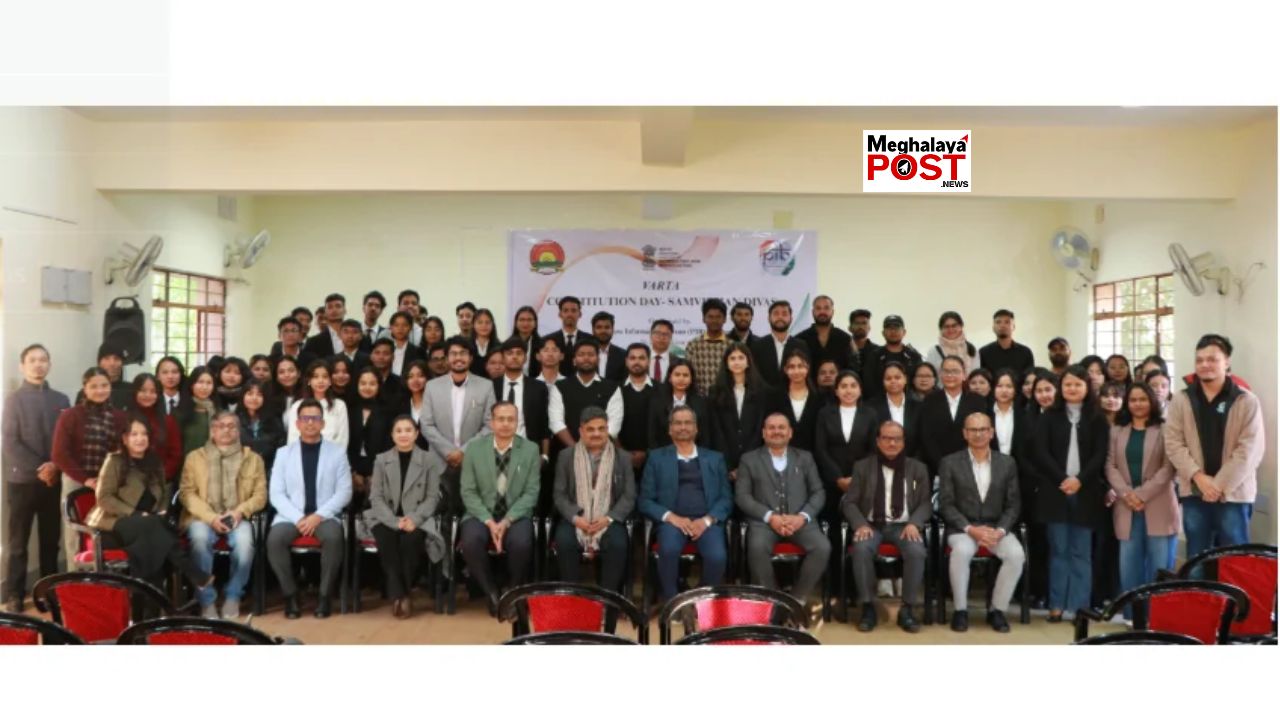
Shillong, November 26: The Press Information Bureau (PIB), Shillong, Ministry of Information and Broadcasting, Government of India, in collaboration with the Department of Law, North-Eastern Hill University (NEHU), organised a special edition of ‘VARTA’ – Media Workshop today, to commemorate Constitution Day – Samvidhan Divas. Centred on the theme “Media as a Partner in Promoting Constitutional Values and Awareness,” the programme brought together media professionals, faculty members, students and invited guests to reflect on the importance of constitutional literacy and the role of media in strengthening democracy.
Welcoming the gathering, Dr. Ravi Kant Mishra, Head, Department of Law, NEHU, acknowledged the initiative and efforts of PIB Shillong in organising the programme in collaboration with the Department. He highlighted the significance of the partnership in creating a platform for meaningful interaction between academia and the media, and in encouraging students to engage more closely with constitutional values and democratic responsibilities.
Prof. S. K. Barik, Vice-Chancellor, NEHU, highlighted the enduring significance of the Constitution and its foundational ideals of justice, liberty, equality and fraternity. Reflecting on 77 years since its adoption on November 26, 1949, he emphasised that constitutional values must be understood and practised in everyday life. Referring to the four pillars of democracy – Legislature, Executive, Judiciary and Press – he underlined their complementary roles in strengthening democratic governance. He encouraged students to understand the Preamble and become responsible citizens and future custodians of the Constitution.
Shri Kripa Shankar Yadav, Additional Director General, NEZ, PIB Guwahati, emphasised that constitutional values should extend beyond textbooks and formal observances and become part of daily life. He highlighted the importance of accessible justice and equal opportunities in education and technology, particularly for people in remote areas and marginalised communities. He also stressed the role of responsible communication and meaningful digital content in promoting constitutional awareness. He encouraged collaboration between the PIB and educational institutions such as NEHU to take awareness initiatives to grassroots communities.
Smt. Ibankyntiew Mawrie, Senior Journalist and Editor-in-Chief, 4Front Media, elaborated on the role of independent journalism in promoting constitutional values and strengthening citizen engagement. She highlighted that media serves as an important link between institutions and the public by making information accessible, encouraging informed discussions and providing a platform for diverse voices. Sharing her experience in establishing an independent media organisation, she spoke about campus interactions, discussions involving experts and stakeholders on local projects and issues, and monthly legal programmes featuring practising lawyers. These programmes explain laws and statutory provisions in simple language, helping citizens understand their legal rights, responsibilities and available remedies. She underlined that such initiatives make legal literacy more accessible, particularly among students and local communities, and encourage meaningful public participation.
Dr. Naveen Kumar, Professor, Department of Law, NEHU, spoke on the constitutional foundations of press freedom under Article 19(1)(a), which guarantees freedom of speech and expression. He referred to landmark Supreme Court judgments that have shaped the understanding of media freedom, including Romesh Thappar v. State of Madras (1950), Sakal Papers v. Union of India (1962) and Indian Express Newspapers v. Union of India (1985). He also discussed Shreya Singhal v. Union of India (2015), on freedom of expression in the digital space, and Anuradha Bhasin v. Union of India (2020), which recognised the significance of internet access for the exercise of freedom of expression. These judgments, he highlighted, demonstrate the important role of the judiciary in interpreting and protecting constitutional freedoms.
The discussions also brought attention to the historical journey and continuing relevance of the Constitution, adopted by the Constituent Assembly on November 26, 1949, after extensive deliberations. The Constitution came into force on January 26, 1950, marking the birth of the Republic of India. Its ideals of justice, liberty, equality and fraternity continue to guide democratic governance, protect citizens’ rights and uphold the dignity of all. The speakers highlighted the importance of understanding these ideals not merely as constitutional principles, but as values to be reflected in public life and everyday conduct.
The interaction offered participants an opportunity to gain insights into the relationship between constitutional values, freedom of expression and responsible journalism. Students, in particular, benefited from the perspectives shared by academic experts and a practising journalist, including discussions on constitutional rights and duties, landmark court judgments, legal awareness and the media’s role in informing citizens. The programme thus provided a valuable platform for connecting classroom learning with contemporary issues concerning democracy and public participation.
The programme concluded with the collective reading of the Preamble to the Constitution, reaffirming the participants’ commitment to its ideals and principles.