

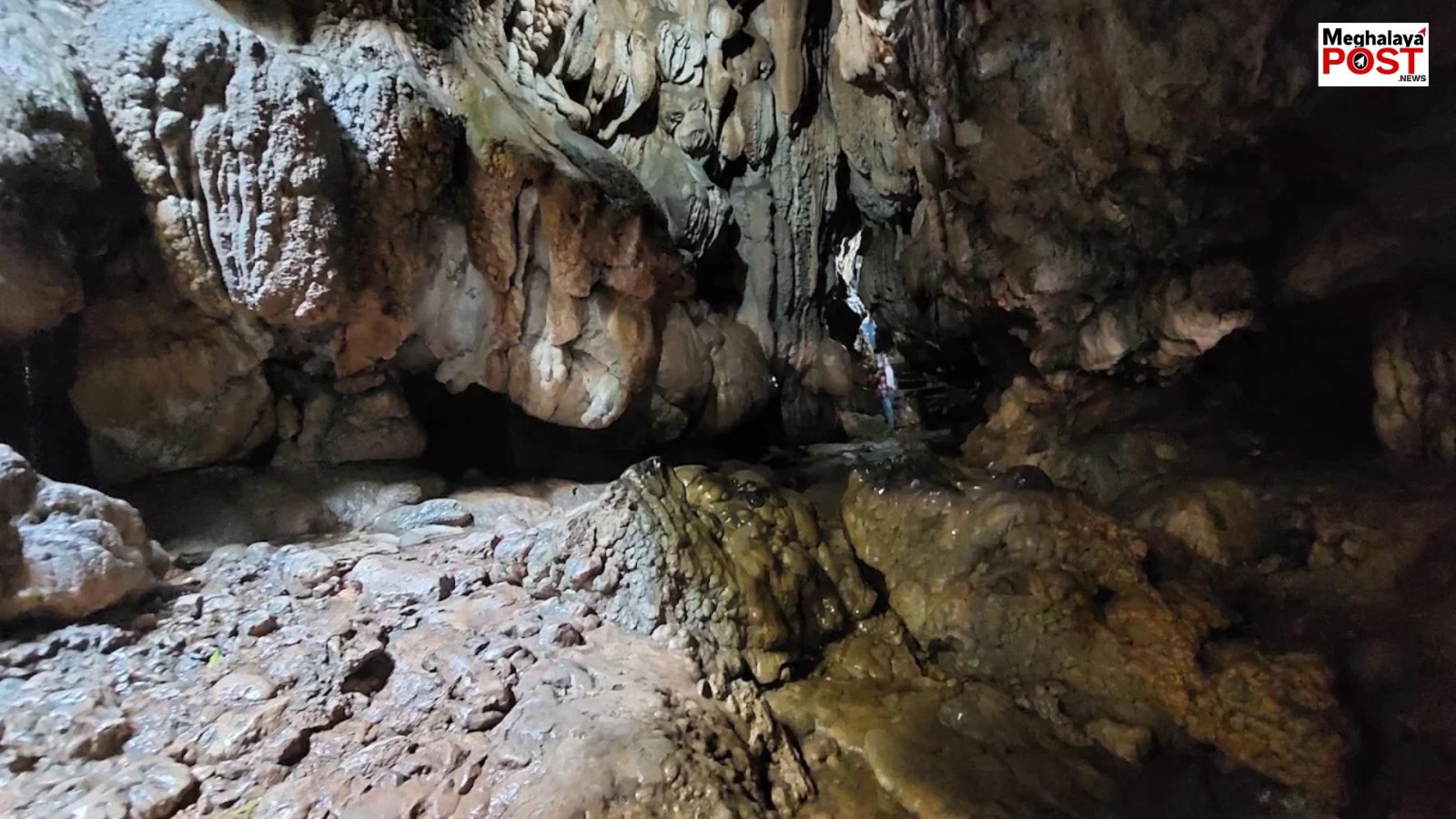
Shillong, Nov 4: A stalagmite found from deep inside the famous Mawsmai Cave in Sohra, East Khasi Hills helped scientists to collect a 6000-year climate record including changes in the Indian Summer Monsoon between 11,807 and 5,622 years ago.
The study titled ‘Deciphering Holocene Monsoon Dynamics In North East India’ was led by Yachna Verma and Anil Gupta of IIT Kharagpur along with Prasanta Sanyal of Indian Institute of Science Education and Research (IISER) Kolkata, co-authors Priyanka Gupta, Som Dutt, Pankaj Kumar and Abhijit Mukherjee. The research paper was published in the international journal ‘Palaeogeography, Palaeoclimatology, Palaeoecology’.
These researchers studied a stalagmite found at a chamber about 300 metres inside Mawsmai Cave. The stalagmite measured 11 cm in length.
They analysed the stable oxygen, isotope composition, petrographic and mineralogical characteristics of the stalagmite.
According to the findings of the research, Indian Summer Monsoon was considerably stronger during the early Holocene, particularly during the period between 11,807 and 7,700 years ago.
The Holocene is the current geological epoch, which began around 11,700 years ago following the last Ice Age.
The researchers also found that monsoon intensity weakened between 7,700 and 5,622 years ago. This was reflected in the rising isotope values in the stalagmite record. Further, the stalagmite record showed that there were recurring climate patterns at intervals of around 118 and 110 years.
This is the second major finding from a cave in Sohra.
Few years ago, scientists defined the Meghalayan Age from the Mawmluh Cave in Sohra.
Study of the stalactites and stalagmites at Mawmluh Cave revealed that around 4,200 years ago, there was a mega drought event and abrupt cooling in the Earth.
The mega drought and cooling lasted for two centuries and caused collapse of agriculture-based societies and civilizations in Egypt, Syria, Palestine, Mesopotamia, the Indus Valley and the Yangtze River Valley