


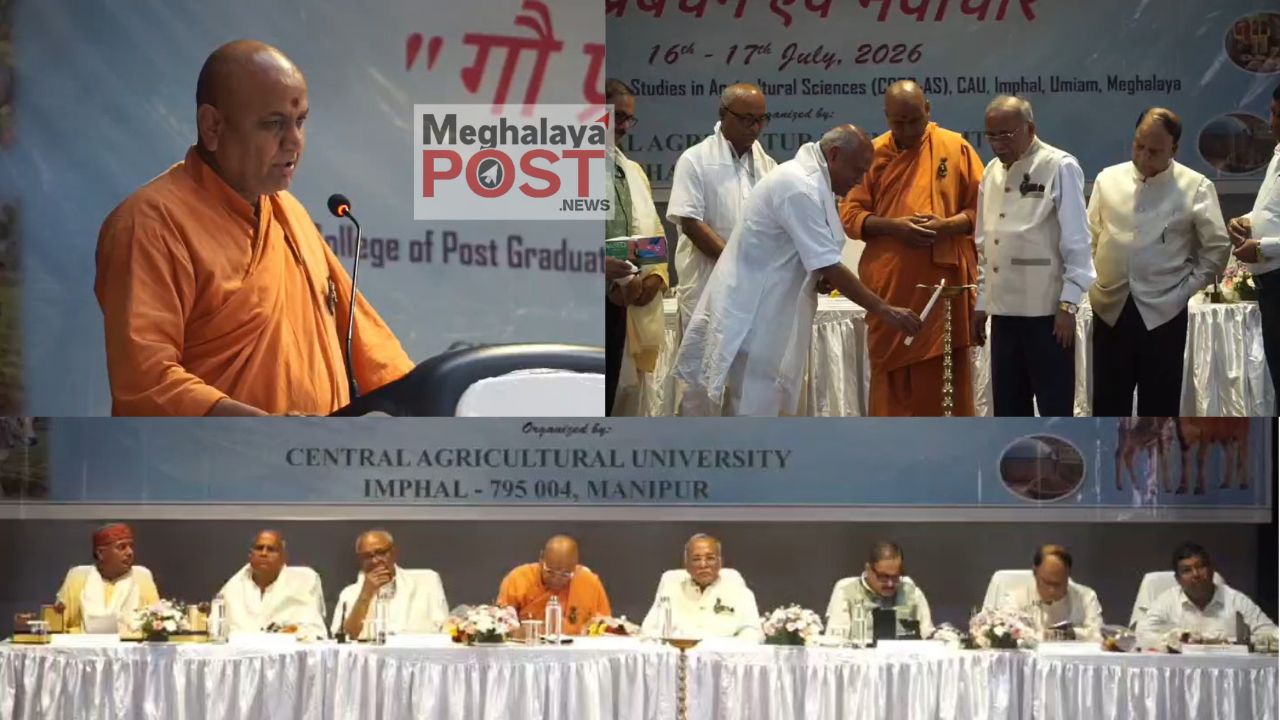
Umiam, July 16: The Central Agricultural University (CAU), Imphal, through the College of Post Graduate Studies in Agricultural Sciences (CPGS-AS), Umiam, inaugurated a two-day workshop on “Cow Management and Innovation on 16 July 2026 at the college campus. The workshop aims to promote sustainable livestock management, indigenous cow conservation, scientific innovations, and collaborative efforts among researchers, policymakers, academicians, and stakeholders.
The inaugural programme commenced with the registration and assembly of participants, followed by the inauguration and visit to exhibition stalls, showcasing innovative technologies and initiatives related to livestock management. The programme continued with the felicitation of distinguished dignitaries and the traditional lighting of the inaugural lamp, symbolizing the beginning of the event.
The programme was graced by Shri. H.H. Adrushya Kadsiddheshwar Swamiji ,49th Mathadhipati, Shri Kshetra Siddhagiri Mahasansthan, Kaneri, Maharashtra, Dr. Anupam Mishra, Hon’ble Vice Chancellor, Central Agricultural University, Imphal, Shri. Dinesh Kumar Tiwari, VHP, Zonal organizing Secretary, Shri Surya Kant Jalan, Chairman, Surabhi Shodh Santhanam, Varanasi, Shri Ullas Kulkarni, Akhil Bharatiya Karyakarini Sadasya, RSS, Guwahati, Dr. Niranjan Kalita, Hon’ble Vice Chancellor, Assam Veterinary and Fishery University, Khanapara, Guwahati, Dr. K. M.Bujarbaruah, Former Vice-Chancellor, Assam Agricultural University (AAU), Jorhat Dr. Arun Kumar Sarma, Director General, NECTAR, Meghalaya, Dr. G. Kadirvel, Director, ICAR-NEH Region, Umiam, Meghalaya, Prof. D. Thakuria, Organizing Chairperson and Dean, CPGS-AS, Umiam.
Also read:SIR Revision: Over 89 % Of Voters Covered In Meghalaya Till Date
Prof. D. Thakuria, Dean, CPGSAS, Umiam highlighted that the workshop would serve as a platform for meaningful deliberations and collaboration towards building a self-reliant, sustainable, and prosperous society through scientific innovation and indigenous knowledge.
Dr. Anupam Mishra, Hon’ble Vice Chancellor, CAU, emphasized the University commitment to research, innovation, and capacity building in agriculture and allied sciences. He stressed that achieving Viksit Bharat 2047requires a self-reliant agricultural sector with reduced dependence on chemical fertilizers through greater use of cow-based products and sustainable farming practices. He highlighted the ecological contributions of indigenous cattle in soil health, biodiversity conservation, water conservation, and environmental sustainability while advocating scientific validation of traditional knowledge.
Delivering the keynote address, Shri.H.H. Adrushya Kadsiddheshwar Swamiji emphasized the spiritual, ecological, cultural, and economic significance of indigenous cattle. He called for scientific validation of traditional practices, conservation of indigenous breeds, and greater utilization of cow-based resources such as dung and urine to strengthen natural farming, biodiversity conservation, and sustainable agriculture.
Dr. Arun Kumar Sarma, Director General, NECTAR, highlighted the importance of technology, innovation, value-added dairy products, livestock entrepreneurship, and natural farming in strengthening the rural economy. He emphasized collaboration among government agencies, research institutions, universities, entrepreneurs, and farmers to realize the vision of Viksit Bharat 2047.
Also watch:
Dr. Niranjan Kalita, Vice Chancellor, Assam Veterinary and Fishery University, stressed scientific animal health management, advanced breeding technologies, conservation of indigenous breeds, and stronger disease management policies for sustainable livestock development.
Dr. K. M. Bujarbaruah, Former Vice Chancellor, Assam Agricultural University, emphasized the role of indigenous cattle in sustainable agriculture and advocated greater research on cow-based bio-products, renewable energy, and the waste-to-wealth approach through collaborative conservation efforts.
Addressing the participants, Shri Ullas Kulkarni underscored the importance of integrating traditional knowledge with scientific research by bringing together farmers, spiritual leaders, researchers, and scientists to promote sustainable livestock development.
Shri Surya Kant Jalan highlighted the need to create awareness among youth regarding the value of indigenous cattle, promote research, and strengthen collaboration for sustainable agriculture and rural development.
Shri Dinesh KumarTiwari emphasized that the workshop provides a common platform for scholars, researchers, cattle rearers, and social workers to discuss conservation and sustainable development of indigenous cattle in North East India. He expressed confidence that the deliberations would strengthen research, innovation, and practical solutions for farmers while contributing to a self-reliant and prosperous region.
The inaugural session was followed by technical sessions where experts deliberated on emerging technologies, scientific innovations, indigenous knowledge, natural farming, and best practices in cow management for sustainable agricultural development.